
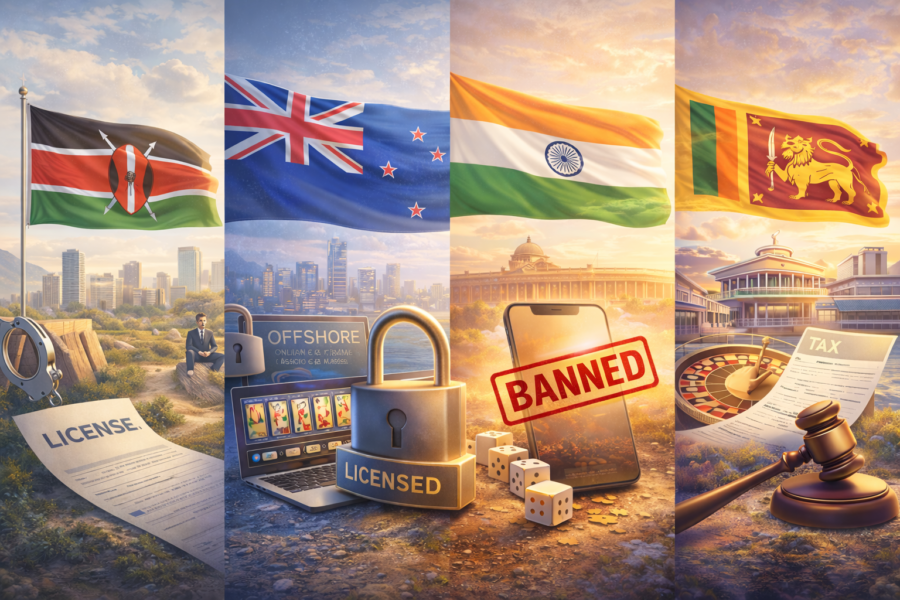
As we reach the final hours of 2025, the online gaming world looks very different from where it started. Four important countries: Kenya, New Zealand, India, and Sri Lanka have introduced major new rules that affect how companies operate, how players gamble, and how governments collect taxes and protect people.
These changes aren’t small tweaks. They’re big shifts from outdated old laws to modern controls, from wild west offshore sites to strict licensed systems, and in one case, an outright ban on anything involving real money.
Let’s walk through what happened in each place this year and where things stand right now.
Kenya: Saying Goodbye to 1960s Rules and Building a Stronger System
For decades, Kenya relied on gambling laws from the 1960s: rules made for physical betting shops, not the fast-moving online world. That changed in August when President William Ruto signed the Gambling Control Act, 2025. This new law creates the Gambling Regulatory Authority of Kenya (GRA), a single powerful body that will handle all licensing, checks, and enforcement.
The switch from the old Betting Control and Licensing Board is still happening. Since October, no new licenses are being issued, and the transition should finish by the end of February 2026. Until then, existing companies can keep running under their current licenses.
Once the GRA is fully up and running, operators will face tougher requirements: at least 30% Kenyan ownership, a local company and office, much higher security deposits (often in the range of KSh 100 million or more), and strong systems for real-time monitoring, anti-money laundering, and player protection. The message is clear – Kenya wants serious, locally connected businesses that play by strict modern rules.
New Zealand: Closing the Door on Offshore Sites and Opening a Controlled Market
New Zealanders have spent huge amounts – hundreds of millions every year on overseas online casinos with almost no local oversight. That free-for-all is ending.
In mid-2025, the government introduced the Online Casino Gambling Bill. It passed its first reading, went through a select committee process with some adjustments, and is moving toward becoming law early next year. The plan is to create a tightly controlled market with up to 15 licenses awarded through a competitive auction.
The process will start in early 2026: companies first prove they’re responsible and safe, then the approved ones bid real money for the limited spots. Winners will have to follow strict rules on age checks, spending limits, and tools to prevent harm. Licensed platforms should start operating around mid-2026, and from July 2026 onward, only licensed sites will be allowed – everything else gets blocked.
This is about bringing money and protection back home while keeping the market small and high-quality.
India: The Boldest Move: Banning Real-Money Games Completely!
India took the strongest action of all. In August 2025, Parliament quickly passed the Promotion and Regulation of Online Gaming Act, 2025, and it became law soon after.
The act bans all “online money games” – any game where players pay to enter and can win cash prizes. This covers popular formats like fantasy sports, poker, rummy, and betting – whether the game relies on skill or luck. The industry, once worth billions and supporting many jobs, faced a sudden stop: apps disappeared from stores, banks blocked payments, sites got restricted, and heavy penalties (fines up to ₹1 crore and even jail time) were introduced for operators and advertisers.
The goal was to fight addiction, fraud, and money laundering. At the same time, the law encourages free-to-play options: social games, educational titles, quizzes, and especially eSports, which now gets official support as a competitive sport. A new authority will register and oversee these safe games with rules on age checks and privacy.
Some companies have closed their real-money parts or challenged the law in court, but as of today, the ban is in full effect.
Sri Lanka: From a Huge Grey Market to One Unified Regulator – Starting Today
For years, most gambling in Sri Lanka happened on unregulated offshore sites – a massive market worth hundreds of millions, completely untaxed. That ends now.
On December 1, 2025 the Gambling Regulatory Authority Act No. 17 of 2025 officially came into force. President Anura Kumara Dissanayake gazetted the start date, creating the independent Gambling Regulatory Authority (GRA) to control everything: land-based casinos, sports betting, lotteries, online platforms, offshore operators targeting Sri Lankans, and even shipboard gambling.
Any company wanting to serve Sri Lankan players must get licensed, follow strong anti-money laundering rules, offer fair play, age verification, spending limits, and pay taxes directly to the GRA (with the betting levy already raised to 18% and local casino entry fees doubled). The full setup will continue into mid-2026, but enforcement begins immediately.
This change aims to capture lost revenue, fight illegal activity, and attract responsible international operators – all while preparing for international reviews on money laundering.
What This All Means for the Future
2025 was the year online gaming regulators got serious. Kenya is localizing and strengthening controls. New Zealand is auctioning exclusive access. India chose to eliminate real-money play entirely. Sri Lanka unified its system and started taxing the grey market today.
These different paths show how fast the world is changing: more protection for players, more revenue for governments, and higher barriers for operators. The easy days of unregulated offshore play are fading fast.
At Clearsky Network, our international gaming lawyers help companies understand these shifts and find the best ways forward. Whether you’re adapting to new rules or exploring fresh opportunities, 2026 starts tomorrow – let’s make sure you’re ready.